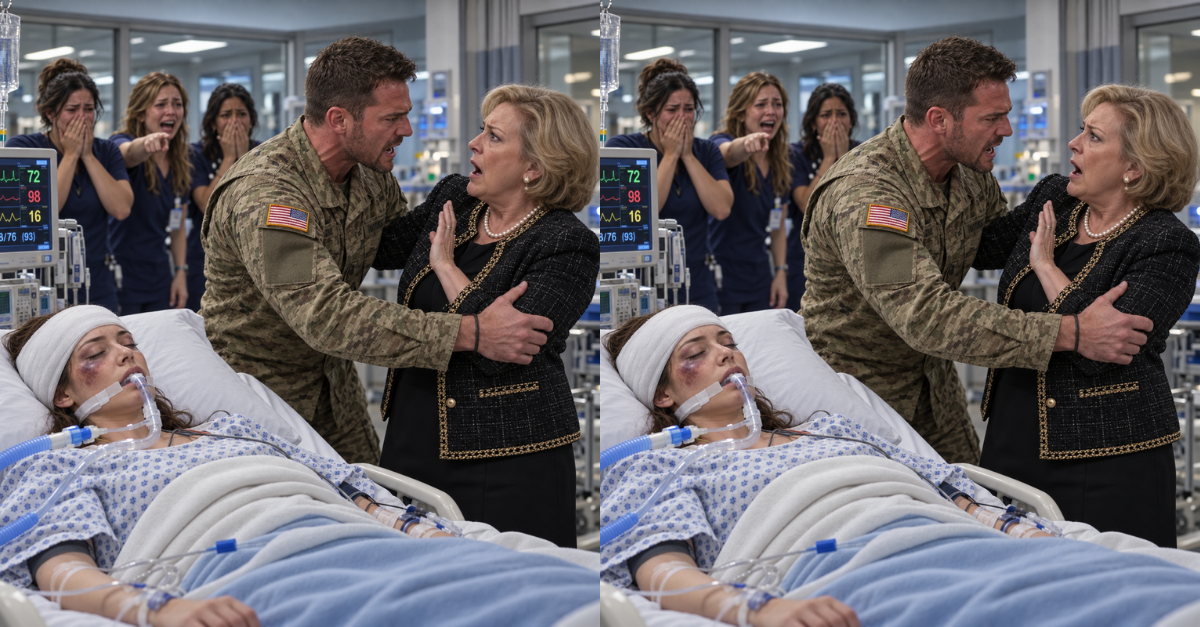
I stepped off a military transport expecting to spend my first night home with my wife.
Instead, I went straight to intensive care.
Rosalie lay beneath a hospital blanket, unconscious, with twenty-seven fractures and a machine helping her breathe.
Outside her room, her mother and six sisters waited beneath the fluorescent lights. Amanda scrolled through her phone. Jessica and Melissa whispered to each other. Catherine Miller checked her watch.
Only Hannah looked frightened.
Detective Thomas Ward pulled me aside.
“Captain, you need to understand something. This family practically owns the entire county.”
I looked through the glass at Rosalie.
“Then we’ll find someone they don’t own.”
Seven months earlier, Rosalie had stood in our kitchen, folding a dish towel she had already folded twice.
“I’ll be fine,” she told me.
I had been leaving for another deployment. She hated goodbyes, so I kissed her forehead and promised I would call whenever I could.
Before I walked out, she caught my sleeve.
“If my mother calls you while you’re gone, talk to me before you believe anything.”
I thought she meant another argument. Another demand that she return to Miller Aerospace, the family company she had left three years earlier.
Standing outside intensive care, I finally understood how little I had known.
Dr. Higgins had described her injuries carefully. Several people might have been involved, he said. Some injuries were consistent with being restrained.
Ward’s explanation was burglary.
But he couldn’t tell me whether the kitchen door had been forced open.
Then he said something I couldn’t stop hearing.
“They arrived before the ambulance.”
“How?”
He glanced toward Catherine.
“I don’t know.”
A few minutes later, Catherine approached me.
“The family will be handling Rosalie’s care.”
“She’s my wife.”
“And you’re rarely around.”
“I was deployed.”
“She needed people she could depend on.”
I looked past her at Hannah’s trembling hands.
“Hannah. What happened inside my house?”
Catherine stepped between us.
“You will not interrogate my daughter.”
“Rosalie is your daughter, too.”
Her expression hardened.
“She stopped being my daughter a long time ago.”
Nobody corrected her.
I looked at Ward.
“Did you hear that?”
He nodded once.
Then I asked the charge nurse to speak privately.
I requested that Rosalie’s visitors be restricted while the circumstances of her injuries were investigated. The nurse brought the attending physician and hospital security.
Catherine demanded the administrator.
Security stayed.
For the first time since I had arrived, she had to wait for someone else’s permission.
Hannah found me beside a vending machine shortly after midnight.
She held a paper cup without drinking from it.
“I didn’t hit her.”
I put down my coffee.
“Then tell me who did.”
Her eyes filled.
“Not here.”
We went to a small consultation room. I left the door open and asked Ward to join us.
Hannah recoiled when she saw him.
“He works for them.”
Ward stopped in the doorway.
For several seconds, nobody spoke.
Then he removed a small notebook from his pocket.
“I’ve let your mother intimidate me,” he said. “That’s true. But I haven’t changed my report.”
“Yet,” Hannah whispered.
He accepted that without arguing.
I pulled out a chair.
“You don’t have to tell him alone. We can get you an attorney.”
Hannah looked at me.
“Will you stay?”
“Yes.”
She began with a blue folder.
Rosalie had called her two days earlier. She had found copies of old company records among boxes stored at our house.
Before she left Miller Aerospace, Rosalie had worked in quality assurance. She had kept notes about components that failed inspection but appeared later on shipment lists as approved.
Back then, Catherine convinced her the discrepancies were clerical errors.
Recently, a former coworker sent Rosalie new records.
The same thing was still happening.
“She was going to report it,” Hannah said. “She asked me to help identify signatures.”
“Did you?”
Hannah nodded.
“Then Amanda saw a message on my phone.”
Catherine called a family meeting at our house.
All seven women came.
Rosalie let them in.
There had been no intruders.
“Mother wanted her laptop and the folder,” Hannah continued. “Rosalie said copies had already gone somewhere safe.”
Amanda grabbed the computer. Charlotte blocked the kitchen doorway.
When Rosalie tried to call for help, Jessica took her phone.
Hannah pressed her hands together.
“Mother told them to hold her.”
Ward’s pen stopped.
“What happened next?”
Hannah couldn’t say it immediately.
When she finally spoke, her voice was almost inaudible.
“Mother picked up the fireplace poker.”
I stared at the table.
I wanted to leave that room and find Catherine.
Instead, I gripped the edge of my chair and stayed where Hannah could see me.
“What did you do?”
“I tried to pull her away. Amanda shoved me into the pantry.”
“Did you call an ambulance?”
“Yes. After they left.”
“From your phone?”
She shook her head.
“Rosalie’s. I found it under the kitchen table.”
Then she explained the hospital.
Catherine had told the sisters to go there together, establish themselves as worried relatives, and repeat the burglary story.
Hannah had followed because she was terrified—and because she needed to know whether Rosalie was alive.
“Why didn’t you tell someone?”
“Because I thought she’d do it to me next.”
Ward closed his notebook.
“We need to preserve your statement. And we need people outside this county.”
This time, he said it without looking toward Catherine first.
My rank didn’t give me control over civilian police.
It didn’t let me search a mansion, seize company records, or arrest my mother-in-law.
What it gave me was enough experience to know the difference between anger and a plan.
Before dawn, I contacted a military legal assistance attorney, who helped me identify the appropriate federal reporting channels for suspected defense-contract fraud.
Ward contacted state investigators about the assault and the local conflicts of interest.
Hannah agreed to provide a formal statement with an attorney present.
Then I went home with investigators.
There was a pale rectangle on the living-room wall where a framed wedding photograph had hung.
The photograph lay facedown beneath a chair.
Rosalie’s slippers were beside the sofa.
One had been turned upside down.
I couldn’t stop looking at it.
An investigator asked whether we had cameras.
“Outside.”
“What about inside?”
“No.”
Then I remembered the doorbell.
The system saved footage to an account Rosalie managed. I didn’t have her password, but I was an authorized user on the household account.
The recording showed Catherine and six daughters arriving at 6:14 p.m.
At 7:03, six women left.
Amanda carried Rosalie’s laptop.
Melissa carried a shopping bag containing something long and heavy.
Hannah emerged eleven minutes later, bent over her phone.
The ambulance arrived after that.
No strangers entered the house during the relevant period.
No one carried away televisions or jewelry.
The rear kitchen door was intact.
Ward watched the footage twice.
Then he stepped outside and made a call.
Rosalie woke on the fourth day.
I was holding her hand when her fingers moved.
Her eyes opened slowly.
“Alex?”
I leaned close.
“I’m here.”
She looked toward the door.
Her breathing quickened.
“Don’t let them—”
“They can’t come in.”
Her eyes found mine again.
“Promise?”
“I promise.”
For a while, that was all we said.
Later, when she was stronger and the doctor permitted a brief conversation, she whispered:
“The folder.”
“They’re looking for it.”
“No. Not blue.”
I frowned.
She swallowed painfully.
“Your letters.”
At home, I opened the wooden box where she kept every letter I had sent her.
Underneath the envelopes was a small flash drive and a folded page in her handwriting.
If something happens before I can explain, give this to someone outside my family.
I sat on the bedroom floor for a long time before I called the investigator.
The drive contained inspection records, payment instructions, emails, and scanned notes.
There was also a message from Catherine.
You don’t understand what you’ll destroy if you send this.
Rosalie’s reply was beneath it.
I understand what could happen if I don’t.
The arrests didn’t happen in a dramatic line outside the hospital.
They happened over several weeks, after interviews, warrants, laboratory work, and arguments between lawyers.
Investigators recovered Rosalie’s laptop from Amanda’s home.
A fireplace tool was found among discarded items at a company storage facility. Forensic testing connected it to the assault.
Phone records contradicted the sisters’ accounts of where they had been.
Messages showed discussions about what to tell police.
Hannah’s statement had opened the investigation. It did not have to carry it alone.
Catherine was arrested first.
Amanda and Charlotte followed. The others faced charges based on their individual actions, including participation in the attack, destruction of evidence, and obstruction.
Hannah was not offered a clean slate merely because she finally spoke. Her conduct was investigated too. She surrendered her phone, admitted what she had done and failed to do, and testified under an agreement reviewed by her attorney.
The company investigation continued separately.
Contracts were suspended. Records were seized. Employees who had spent years afraid to speak began coming forward.
Catherine’s name remained on buildings around town.
It no longer stopped people from asking questions.
Recovery was slower than the investigation.
Rosalie had surgeries, exhausting therapy appointments, headaches, and days when she couldn’t tolerate being touched.
Sometimes she woke convinced someone was standing outside our bedroom.
Sometimes she apologized for needing help.
Those apologies hurt more than I knew how to explain.
One afternoon, she watched me cut her lunch into smaller pieces.
“You didn’t come home for this.”
I set down the knife.
“I came home to you.”
She turned away, crying.
I stayed beside her until she was ready to eat.
We sold the house before the trial.
She said she could hear the kitchen door opening even when it was closed.
I never asked her to try harder to stay.
At trial, Catherine wore pearls.
Her attorney described her as a devoted mother whose family disagreement had spiraled beyond her control.
Rosalie listened without moving.
Then the prosecutor displayed the messages.
The doorbell footage.
The photographs.
The company records.
Hannah testified with both hands wrapped around a glass of water.
When Catherine’s attorney accused her of betraying her family, Hannah looked toward Rosalie.
“I already betrayed my sister,” she said. “I’m trying to stop.”
Rosalie cried silently.
She did not look away.
Catherine was convicted of attempted murder and conspiracy. Several daughters were convicted of assault-related offenses and obstruction; others had entered guilty pleas and cooperated.
The defense-contract case brought further convictions and restitution orders.
There was no single afternoon when everything became right.
There was a verdict.
Then another medical appointment.
Then a night Rosalie slept without waking afraid.
Those were the things we learned to count.
Nearly two years after I came home, Hannah visited our new house.
Rosalie had invited her.
They sat on the porch with tea between them.
“I don’t know how to forgive you yet,” Rosalie said.
Hannah nodded.
“I know.”
“But you can come next Sunday.”
That was where they began.
Later, after Hannah left, Rosalie stood at the porch steps. She still used a cane when she was tired.
I reached for her arm.
She smiled.
“Let me try.”
So I waited.
She took the steps slowly, then crossed the short path to the garden we had planted together.
At the gate, she turned back.
For seven months overseas, I had imagined coming home to her waiting for me.
For a long time after the hospital, I thought that picture had been taken from us forever.
But there she was.
Not untouched. Not healed in every way.
Alive, making choices, standing in a place her mother had never entered.
“You coming?” she asked.
I walked toward her.
This time, there was no one between us.