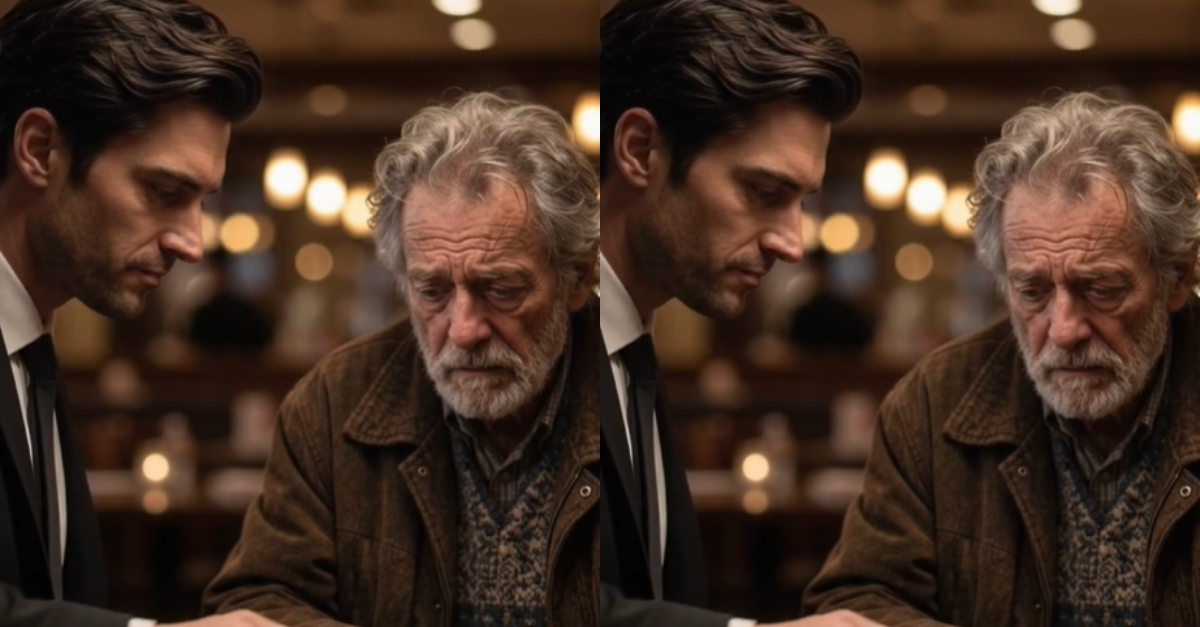
“THIS FOOD ISN’T FOR BEGGARS!”
The plate disappeared from the old man’s table.
CLANG!
Daniel Brooks dumped the entire meal into the trash.
Meat.
Potatoes.
Bread.
Everything.
The old man reached out helplessly.
“Please…”
His voice shook.
“That’s all I have.”
Daniel looked at his torn brown coat, patched trousers and worn shoes.
Then he laughed.
“If that’s all you have, you shouldn’t be eating here.”
Several diners turned.
Nobody spoke.
The old man lowered his eyes.
Daniel grabbed the battered wallet lying beside him and slapped it onto the table.
A few crumpled bills fell out.
“YOU CALL THAT MONEY?”
The old man slowly gathered them.
“I worked here once.”
Daniel smirked.
“Sure you did.”
“I did.”
“Then maybe you should know this is a five-star restaurant now.”
The old man stared around the room.
For a moment, something changed in his eyes.
Recognition.
Pain.
Memory.
“I know.”
Daniel didn’t notice.
But Eleanor Whitmore did.
She had been dining three tables away.
Sixty-five years old, silver hair arranged neatly in a low bun, Eleanor had visited the restaurant for decades.
She was about to call Daniel over when something on the old man’s coat caught the light.
A small brass badge.
Oval.
Scratched.
Almost black with age.
Eleanor stopped breathing.
She pushed back her chair.
Slowly.
Then walked toward him.
“Where did you get that badge?”
The old man touched it instinctively.
“It was given to me.”
Eleanor came closer.
Her hands began to tremble.
On the front was a tiny engraved flame surrounded by laurel leaves.
Beneath it were three worn letters.
S.R.H.
Eleanor knew that badge.
She had watched it being made.
“Only one man ever wore this.”
Daniel rolled his eyes.
“Who?”
Eleanor looked at the old man.
Her voice broke.
“The man who saved my daughter’s life.”
The restaurant fell completely silent.
The old man slowly raised his face.
Eleanor stared at him.
Then whispered:
“Samuel?”
His eyes filled with tears.
“Nora?”
Nobody had called Eleanor that in nearly forty years.
She covered her mouth.
“Oh my God.”
Samuel Reed had been twenty-nine when he first entered that restaurant.
Back then, it wasn’t famous.
It was a modest family dining room called Whitmore House.
Eleanor’s father owned it.
Samuel started as a dishwasher.
Within a year, he was repairing broken ovens, carrying deliveries, helping cooks and serving tables whenever someone was absent.
He never complained.
He never made much money.
But everyone trusted him.
Especially Eleanor.
She was twenty-six then, recently married and helping her father run the restaurant.
Her daughter, Claire, was only eighteen months old.
One winter evening, the kitchen caught fire.
A damaged gas line ignited behind the main ovens.
Flames spread through the rear corridor before anyone understood what was happening.
Guests escaped through the front.
Employees ran outside.
Then Eleanor screamed.
Claire was still upstairs.
The restaurant had a small family apartment above the kitchen.
Eleanor tried to run back inside.
Samuel stopped her.
Then he went in himself.
Smoke filled the stairwell.
Part of the ceiling collapsed.
Samuel disappeared for almost four minutes.
Everyone outside believed he was dead.
Then he emerged through a side door.
His jacket was burning.
And in his arms was Claire.
Alive.
Samuel suffered burns on one arm and severe smoke inhalation.
He spent twelve days in the hospital.
Eleanor’s father wanted to give him money.
Samuel refused.
So instead, Mr. Whitmore had a single brass badge made.
Not an employee award.
Not something mass-produced.
One badge.
On the back were the words:
For courage when everyone else ran.
Samuel wore it on his work jacket for years.
And Mr. Whitmore made another promise.
“You’ll always have a meal at my table.”
Samuel smiled.
“I’ll remember that.”
For nearly fifteen years, the promise was honored.
Then Eleanor’s father died.
The restaurant was sold during a difficult period for the family.
Eleanor moved away.
Samuel stayed.
But the new owner changed everything.
Staff were replaced.
Costs were cut.
And Samuel discovered that the new management was secretly deducting money from employees’ paychecks for meals they had never ordered.
He complained.
Management accused him of stealing cash.
Samuel denied it.
Nobody listened.
He was fired.
Worse, the owner told other restaurants that Samuel could not be trusted.
His reputation collapsed.
He found temporary work.
Warehouses.
Maintenance.
Construction.
Then his wife became ill.
Medical bills consumed their savings.
She died eight years later.
Samuel never fully recovered financially.
By his seventies, he was living in a small rented room and surviving on a modest pension.
He kept only a few things from his old life.
A photograph of his wife.
A pocketknife.
And the brass badge.
Eleanor had known none of this.
“I searched for you,” she said.
Samuel gave a sad smile.
“I moved around.”
“I thought you had family.”
“My wife died.”
“And Claire?”
Samuel looked away.
“What about her?”
Eleanor began crying.
“She’s alive because of you.”
Samuel nodded.
“That was enough.”
“No.”
Eleanor took his hand.
“It wasn’t.”
Daniel stood nearby, suddenly pale.
He looked at the old man’s worn coat.
Then at Eleanor.
He knew exactly who she was.
Eleanor Whitmore was not merely a regular customer.
Her family’s investment company had quietly reacquired a major stake in the restaurant group two years earlier.
Daniel swallowed.
“Mrs. Whitmore, I didn’t know—”
Eleanor turned.
“Know what?”
Daniel hesitated.
“That he was…”
“What?”
Daniel had no answer.
Eleanor stepped closer.
“Important?”
The word landed harder than a shout.
Daniel looked down.
Eleanor continued.
“If he hadn’t saved my child, would throwing his food away have been acceptable?”
“No.”
“If he had never worked here?”
“No.”
“If that badge meant nothing?”
Daniel remained silent.
Samuel spoke softly.
“I don’t want anyone fired because of me.”
Eleanor looked at him.
“This isn’t only about you.”
And she was right.
The restaurant’s owners reviewed the security footage.
Then they interviewed employees.
What they discovered was disturbing.
Daniel had repeatedly treated poorly dressed customers differently.
An elderly woman had been asked to leave because he assumed she couldn’t afford dinner.
Delivery drivers were forbidden from using the main restroom.
A homeless veteran who entered during winter asking for water had been pushed back outside.
Several employees had complained.
Nothing happened because Daniel consistently produced strong revenue numbers.
He was suspended immediately.
After a formal investigation, he was dismissed.
But Eleanor refused to turn Samuel’s story into a publicity stunt.
She offered him money.
He declined.
She offered him an apartment.
He hesitated.
Then she said:
“You saved Claire when she couldn’t save herself.”
Samuel looked at her.
“Let us help you now.”
Eventually, he accepted one thing.
A small apartment owned by the family trust.
Not luxury.
Not a mansion.
Just safety.
Then Eleanor fulfilled her father’s forgotten promise.
Samuel would never pay for a meal at Whitmore House again.
The restaurant also restored something else.
Near the entrance, they installed a small framed photograph.
Samuel stood beside Eleanor’s father outside the restaurant decades earlier.
Under it was the brass badge’s inscription:
For courage when everyone else ran.
There was no mention of Samuel’s poverty.
No mention of Daniel.
Samuel insisted on that.
“I don’t want people remembering me because someone humiliated me.”
“What should they remember?” Eleanor asked.
He smiled.
“That once, somebody needed help.”
A month later, Claire came to see him.
She was forty years old now.
A mother herself.
When Samuel saw her, he stared for several seconds.
Then laughed softly.
“You got tall.”
Claire burst into tears.
She hugged him.
“My mother told me what you did.”
Samuel shrugged.
“I carried a little girl down some stairs.”
“You ran into a burning building.”
“You needed somebody.”
That was all he ever said about it.
The story eventually spread among employees.
A poor old man had walked into an expensive restaurant carrying only a few crumpled bills.
The manager saw his clothes and decided he didn’t belong.
Then an old brass badge revealed a forgotten history.
But Eleanor always corrected people when they told it that way.
Samuel’s past was not what made Daniel’s cruelty wrong.
The badge did not make him worthy of dinner.
Saving Claire did not make him deserving of dignity.
Samuel deserved that before anyone recognized him.
Before Eleanor stood up.
Before anyone knew his name.
And that became the lesson Whitmore House never forgot:
The poorest person at the table may have a story nobody knows.
But even if he doesn’t—
you still don’t throw away his food.