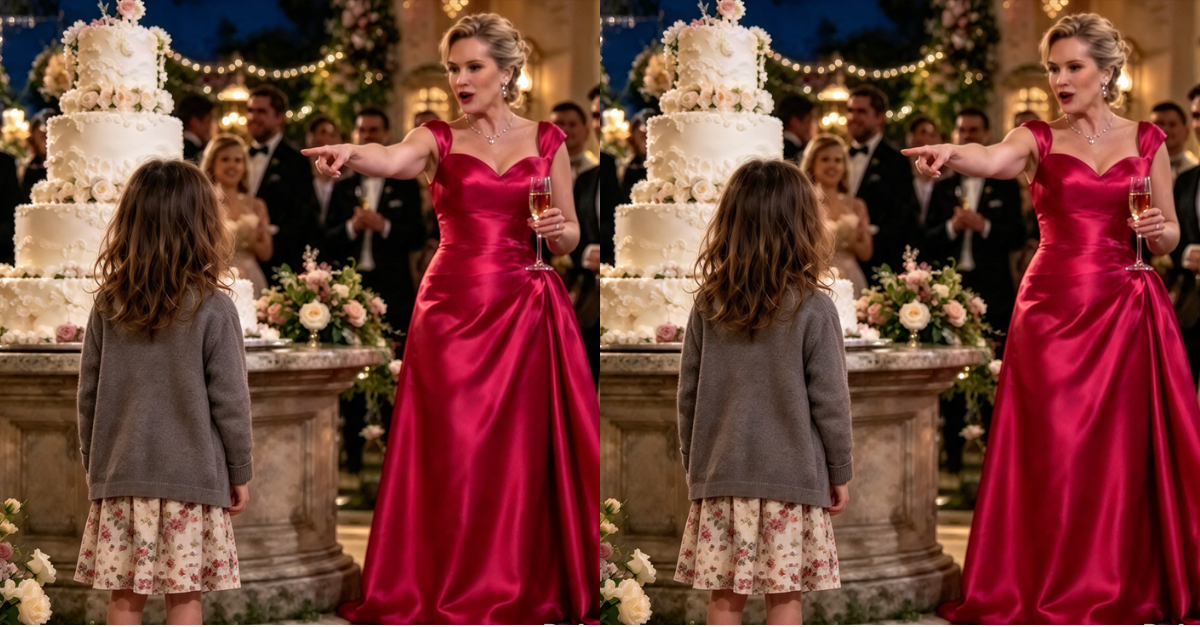
“Get that girl out of here!”
Victoria’s voice cut through the music like a knife.
More than a hundred guests turned toward the enormous white cake in the center of the garden.
That was where the little girl stood.
Barefoot.
Dirty.
Terrified.
Her old cream-colored dress hung loosely from her small frame, and one sleeve of her gray-brown cardigan was torn near the wrist.
Her brown hair was tangled.
There was dirt across one cheek.
And she was staring at the cake as if she hadn’t eaten all day.
A waiter immediately moved toward her.
“Come on, sweetheart.”
The little girl stepped backward.
“No…”
Victoria Sinclair lifted her champagne glass and pointed toward the gate.
“I said get her out. I have no idea how she got in here.”
The waiter reached for the child’s shoulder.
“Wait!”
The voice came from behind them.
Alejandro Sinclair crossed the lawn quickly.
Thirty-five years old.
Navy suit.
Dark hair.
The man whose promotion to CEO was supposedly the reason everyone had gathered that night.
He was carrying a small plate with a piece of cake.
Alejandro raised one hand toward the waiter.
“Let her eat.”
Victoria’s expression tightened.
“Alejandro, this is a private event.”
“I can see that.”
He knelt in front of the little girl.
Up close, he could see that she had been crying.
“What’s your name?”
The girl didn’t answer.
Alejandro held out the cake.
“You can have it.”
Her eyes moved toward the plate.
Then back to him.
Her lower lip trembled.
Finally, she whispered:
“Mom told me to find you… if she never came back.”
Alejandro stopped breathing.
Slowly, he lowered the plate.
“What?”
The little girl’s eyes filled again.
Alejandro leaned closer.
“What’s her name?”
Behind him, Victoria went completely still.
The little girl gripped the edge of her cardigan.
“Lucía.”
Alejandro’s face changed.
The girl swallowed.
“Lucía Romero.”
The champagne glass nearly slipped from Victoria’s hand.
Alejandro turned.
His mother’s face had gone white.
And in that instant, before Victoria said a single word, Alejandro knew something was terribly wrong.
Eight years earlier, Alejandro had planned to marry Lucía Romero.
Almost no one at the garden party knew that.
Victoria had made sure of it.
Lucía wasn’t from Alejandro’s world.
She had grown up twenty minutes away from the Sinclair estate in a small apartment above her mother’s bakery.
Her father died when she was eleven.
Her mother worked fourteen-hour days.
Lucía worked too.
By twenty-three, she was studying architecture during the day and helping at the bakery before sunrise.
Alejandro met her because of coffee.
Or at least that was how he always told the story.
He had walked into Romero Bakery one rainy morning after his car broke down nearby.
Lucía was behind the counter.
“You look miserable,” she told him.
Alejandro stared at her.
“Excuse me?”
“You’re soaking wet and staring at the menu like it personally offended you.”
He laughed.
That was the beginning.
Alejandro returned the following morning.
Then the morning after that.
Within six months, he was in love.
Within eighteen months, he had bought a ring.
Victoria was horrified.
“You cannot marry her.”
Alejandro remembered the exact conversation.
He had been twenty-seven.
Victoria sat behind the massive walnut desk in her private study.
“She’s not a criminal, Mother.”
“That is not what I said.”
“Then what exactly is wrong with her?”
Victoria’s mouth tightened.
“She does not understand our life.”
“Neither did you when you married Dad.”
Victoria went silent.
Alejandro knew he had hit the truth.
His mother had not been born wealthy either.
But after thirty years inside the Sinclair family, she guarded its status more fiercely than anyone.
“Lucía makes me happy.”
“Happiness is not enough to build a marriage.”
“It’s enough for me.”
Victoria stared at him.
“You’ll regret this.”
Alejandro smiled.
“I doubt it.”
He walked out.
Three weeks later, Lucía disappeared.
There was no dramatic goodbye.
No final argument.
Alejandro went to her apartment one evening and found it empty.
Her clothes were gone.
Her phone had been disconnected.
The bakery was closed.
Her mother had vanished too.
On the kitchen table was an envelope.
Alejandro recognized Lucía’s handwriting.
Inside were only four sentences.
Alejandro,
I’m sorry.
I can’t live your life, and you cannot live mine.
Please don’t look for me.
He did anyway.
For months.
Private investigators.
Friends.
Hospitals.
University records.
Nothing.
Eventually, one investigator found evidence that Lucía and her mother had moved to Mexico.
Then the trail ended.
Alejandro was devastated.
Victoria was sympathetic.
Almost too sympathetic.
“She made her choice,” she told him.
He hated hearing it.
But eventually, he believed it.
What else could he do?
Lucía had left.
She had asked him not to follow.
So Alejandro buried the engagement ring in the back of a desk drawer and built the life everyone expected him to build.
He never married.
Victoria told people her son was “married to his company.”
Alejandro allowed them to believe it.
It was easier than explaining that the only woman he had wanted had disappeared without looking back.
Until a barefoot seven-year-old arrived at his garden party.
Alejandro slowly stood.
“Sofía?”
The girl nodded.
“How old are you?”
“Seven.”
His stomach tightened.
“When is your birthday?”
Victoria suddenly interrupted.
“Alejandro, this is absurd.”
He turned sharply.
“Why?”
“This child could have heard Lucía’s name anywhere.”
Sofía flinched at Victoria’s tone.
Alejandro immediately stepped between them.
“Don’t speak to her like that.”
Victoria stared at him.
“Alejandro—”
He turned back to Sofía.
“When is your birthday?”
“October nineteenth.”
Alejandro did the calculation automatically.
Then did it again.
Seven years.
Almost eight.
Lucía disappeared eight years earlier.
His pulse began hammering.
Victoria knew exactly what he was thinking.
“This proves nothing.”
Alejandro looked at her.
“I didn’t say it did.”
“No, but I know that look.”
“Do you?”
Something about Victoria’s expression bothered him.
Not confusion.
Not surprise.
Fear.
Pure fear.
Alejandro crouched again.
“Sofía, where is your mother?”
The little girl’s face collapsed.
“I don’t know.”
“What happened?”
“She went to work.”
“When?”
“Three days ago.”
“And she didn’t come home?”
Sofía shook her head.
Alejandro felt cold.
“Who were you staying with?”
“Mrs. Alvarez.”
“Who is she?”
“Our neighbor.”
“Why aren’t you with her now?”
Sofía pulled something from the pocket of her cardigan.
A folded piece of paper.
“My mom gave me this.”
Alejandro took it.
An address was written in faded blue ink.
The Sinclair estate.
And beneath it:
Find Alejandro Sinclair.
Alejandro stared at the handwriting.
His knees almost weakened.
He knew that handwriting.
He had carried a letter written in it for eight years.
Victoria stepped forward.
“Give me that.”
Alejandro looked up.
“Why?”
Victoria froze.
“You don’t know what that is.”
“Yes, I do.”
“Alejandro—”
“It’s Lucía’s handwriting.”
Several guests had begun whispering.
Victoria glanced around.
“We should discuss this inside.”
For the first time, Alejandro agreed with her.
Not because he wanted privacy for Victoria.
Because Sofía was trembling.
He lifted the little girl carefully.
She hesitated for half a second, then wrapped both arms around his neck.
The sensation did something to him he could not explain.
Maybe instinct.
Maybe fear.
Maybe hope he was too afraid to acknowledge.
As Alejandro carried Sofía toward the house, he glanced back.
Victoria was still standing beside the cake.
Her champagne glass was shaking.
Inside, Alejandro took Sofía to the family room.
One of the housekeepers brought her food.
Not cake.
Soup.
Bread.
Fruit.
Sofía ate too quickly.
Alejandro pretended not to notice.
Then he asked:
“Can you tell me about your mom?”
Sofía nodded.
“What does she do?”
“She cleans rooms at a hotel.”
“Where do you live?”
“On Maple Street.”
That surprised him.
“Here?”
She nodded.
“In the city?”
Another nod.
Lucía had been living less than thirty miles away.
For how long?
“Did your mom ever talk about me?”
Sofía looked down.
“Sometimes.”
“What did she say?”
“That you were kind.”
Alejandro swallowed.
“What else?”
“She said you loved chocolate cake.”
He almost laughed.
Lucía used to tease him because he hated every dessert except chocolate cake.
“What else?”
Sofía thought.
“She said you have a little scar here.”
She touched her eyebrow.
Alejandro unconsciously raised his hand.
A small scar crossed his left eyebrow from a bicycle accident when he was fourteen.
Few people knew the story.
Victoria entered before he could ask another question.
“We need to talk.”
Alejandro didn’t look at her.
“Later.”
“Now.”
Something in her voice made him turn.
He asked the housekeeper to stay with Sofía.
Then followed Victoria into the library.
The moment the door closed, he said:
“What did you do?”
Victoria recoiled.
“Excuse me?”
“You know something.”
“You are emotional.”
“Mother.”
“A random child walks into the garden, says Lucía’s name, and suddenly you’re ready to rewrite eight years of history.”
“Why were you terrified?”
“I wasn’t.”
“You dropped your glass.”
“I was surprised.”
“No.”
He stepped closer.
“You were afraid.”
Victoria looked away.
That was enough.
Alejandro’s voice lowered.
“What did you do?”
Victoria walked toward the window.
For a long time, she said nothing.
Then:
“I protected you.”
Alejandro felt his stomach turn.
“From what?”
“From a life you did not understand.”
“Answer me.”
“She was going to ruin everything.”
“Lucía?”
“You were twenty-seven.”
“I was an adult.”
“You were about to inherit control of the company.”
“And?”
“Your grandfather had made his position clear.”
Alejandro frowned.
“What position?”
Victoria turned.
“If you married her, he intended to challenge your succession.”
Alejandro stared.
“My inheritance?”
“Your voting control.”
“He never told me that.”
“Because I dealt with it.”
Alejandro took a step backward.
“What does that mean?”
Victoria’s face tightened.
“I spoke with Lucía.”
His chest went cold.
“When?”
“Before she left.”
“What did you say?”
Victoria did not answer.
Alejandro shouted:
“What did you say to her?”
“She needed to understand reality!”
Sofía startled in the next room.
Alejandro immediately lowered his voice.
“Tell me.”
Victoria looked suddenly older.
“I offered her money.”
He stared at her.
“How much?”
“Enough.”
“How much?”
“One million dollars.”
Alejandro laughed once.
There was no humor in it.
“And she took it?”
Victoria hesitated.
“No.”
That answer surprised him.
“She refused?”
“Yes.”
“Then why did she leave?”
Victoria’s eyes filled with something dangerously close to shame.
“I told her you had agreed.”
Alejandro stopped moving.
“What?”
“I told her you had decided the relationship had become inconvenient.”
“No.”
“She didn’t believe me at first.”
“No.”
“So I showed her documents.”
“What documents?”
Victoria swallowed.
“Your engagement agreement.”
“My what?”
“I had attorneys draft a financial agreement. I told her you had prepared it.”
Alejandro shook his head.
“I never saw any agreement.”
“I know.”
His face went numb.
“You forged my instructions?”
“I was protecting—”
“Stop saying that!”
Victoria flinched.
Alejandro pointed toward the door.
“There is a seven-year-old child in the next room whose mother vanished three days ago.”
Victoria closed her eyes.
“And now you’re telling me you drove Lucía away?”
“I thought it was over.”
“What else?”
Victoria said nothing.
Alejandro saw it immediately.
“There’s more.”
“Alejandro…”
“What else?”
Victoria’s voice dropped to a whisper.
“She came back.”
His world stopped.
“When?”
“About seven months after she left.”
The timing hit him before the words did.
Seven months.
“Was she pregnant?”
Victoria began crying.
Alejandro stepped backward.
“Oh my God.”
“She was.”
“Was the baby mine?”
“She said yes.”
He stared at his mother as if she were a stranger.
“And you didn’t tell me?”
Victoria’s tears fell.
“She had no proof.”
“She was seven months pregnant!”
“She wanted money.”
“You just said she refused your money!”
“She wanted access to you.”
“She was carrying my child!”
“We didn’t know that!”
“Did you ask for a test?”
Victoria said nothing.
Alejandro understood.
“You didn’t.”
“No.”
“You sent her away again.”
“I gave her enough to start over.”
“Did she take it?”
A long pause.
“Yes.”
Alejandro laughed bitterly.
“Of course she did. She was pregnant and alone.”
Victoria wiped her face.
“I thought it was best.”
“For whom?”
No answer.
“For whom, Mother?”
Victoria looked at him.
“For the family.”
Alejandro opened the library door.
“You’re not my family right now.”
Sofía was still eating when Alejandro returned.
He sat across from her.
His hands felt strangely numb.
“Sofía?”
She looked up.
“Do you have a picture of your mom?”
The girl nodded and reached inside her cardigan.
She pulled out a small, worn photograph.
Alejandro took it.
Lucía.
Older.
Tired.
But unmistakably Lucía.
She was standing beside Sofía.
His eyes moved to the little girl.
Then back to the photograph.
Sofía had Lucía’s mouth.
But her eyes—
His eyes.
Alejandro stared at them.
Sofía became nervous.
“Did I do something wrong?”
His heart broke.
“No.”
He immediately moved beside her.
“No, sweetheart. You did everything right.”
“Are you Alejandro?”
“Yes.”
“My mom said you would help me.”
He struggled to keep his voice steady.
“I will.”
“Promise?”
Alejandro looked at her.
“Promise.”
Within twenty minutes, his security team had Sofía’s address.
Alejandro went there personally.
The apartment was small.
Clean.
A child’s drawings covered one wall.
There were two mugs beside the sink.
One adult.
One child.
Lucía’s work uniform hung behind the bathroom door.
Her phone sat on the kitchen counter.
That worried Alejandro immediately.
People did not usually disappear voluntarily without their phones.
Police were called.
The missing-person case was reopened with urgency after officers learned Lucía had not reported to work for three days.
Then Alejandro found the box.
It was hidden inside the top shelf of a closet.
His name was written across the lid.
Inside were letters.
Dozens.
Every one addressed to:
Alejandro Sinclair.
Some dated eight years earlier.
Some seven.
Six.
Five.
The most recent was three months old.
None had been mailed.
Alejandro sat on the floor.
He opened the oldest one.
Alejandro,
Your mother says you want nothing to do with me. I don’t believe her, but I don’t know what else to believe because every number I have for you has stopped working.
Alejandro’s hands began shaking.
Another letter.
I’m pregnant.
He stopped reading.
For several seconds, he couldn’t breathe.
Then he forced himself to continue.
I don’t know if you would be happy or angry. I want to believe happy.
Another.
She’s a girl.
Another.
I named her Sofía because my mother says wisdom is knowing when hope becomes foolish. I still hope you will find us, so maybe I have learned nothing.
Alejandro covered his mouth.
Eight years.
His daughter had been alive for seven of them.
Less than thirty miles away.
The police found Lucía the following morning.
She was alive.
Barely.
She had been injured in a traffic accident on her way home from work.
Her bag contained no current identification because her wallet had been stolen weeks earlier and she had been waiting for replacements.
She had been admitted to a county hospital as an unidentified patient.
Alejandro reached the hospital twenty minutes after receiving the call.
Sofía was with him.
Doctors warned him Lucía was unconscious.
Stable.
But seriously injured.
Sofía sat beside her mother’s bed.
Alejandro remained near the door.
He didn’t feel entitled to come closer.
Not yet.
Then Lucía opened her eyes.
Sofía immediately leaned forward.
“Mom!”
Lucía’s fingers moved weakly toward her daughter.
Then her eyes shifted.
She saw Alejandro.
Everything in her face changed.
Not happiness.
Not relief.
Fear.
“Alejandro?”
He couldn’t speak.
Lucía looked at Sofía.
Then back at him.
“How did you…”
Sofía answered.
“I found him.”
Lucía closed her eyes.
A tear slipped down her cheek.
“You weren’t supposed to unless I didn’t come back.”
“You didn’t.”
“I know, baby.”
Alejandro stepped closer.
“Lucía.”
She looked at him.
He held one of the letters.
Her face went pale.
“You found those.”
“Yes.”
Silence.
“Why didn’t you send them?”
Lucía laughed weakly.
“I sent the first six.”
He froze.
“What?”
“They came back.”
Alejandro looked at her.
“Returned?”
“Yes.”
“All of them?”
She nodded.
“Then someone called me.”
“Who?”
Lucía hesitated.
“Your mother.”
Of course.
“She said if I continued contacting you, your lawyers would accuse me of harassment and try to take Sofía.”
Alejandro closed his eyes.
Lucía continued.
“I was terrified.”
“I didn’t know.”
“I know.”
“No.”
He moved closer.
“You need to understand. I didn’t know any of this.”
Lucía watched him.
“Your mother told me you did.”
“She lied.”
Lucía’s eyes filled.
“So did she.”
For the first time in eight years, both of them understood exactly what had happened.
A DNA test was unnecessary emotionally.
But legally, Alejandro insisted on one.
The result came four days later.
Probability of paternity: 99.9998%.
Sofía Romero was Alejandro Sinclair’s daughter.
Alejandro stared at the report.
Then cried for almost an hour alone in his car.
He cried for Lucía.
For Sofía.
For seven birthdays he missed.
Seven Christmas mornings.
First steps.
First words.
Her first day of school.
Every fever.
Every nightmare.
Every time she asked Lucía about her father.
All stolen.
Not by distance.
Not by fate.
By a decision made in a beautiful house by someone convinced she knew what was best for everyone else.
Victoria asked to see him.
Alejandro refused.
Then she asked to see Sofía.
He refused that too.
“I’m her grandmother.”
Alejandro looked at her across the lawyer’s conference table.
“No.”
Victoria’s face hardened.
“You cannot erase biology.”
“I’m not.”
“Then why won’t you let me meet her?”
“Because being biologically related to a child does not automatically make you safe for that child.”
Victoria went quiet.
“You took seven years from me.”
“I know.”
“More importantly, you took seven years from Sofía.”
“I know.”
“And eight years from Lucía.”
Victoria looked down.
“I thought she would move on.”
“She did.”
Alejandro’s voice broke.
“She raised my daughter alone.”
Victoria started crying.
“I was wrong.”
“Yes.”
“I was trying to protect your future.”
Alejandro stared at her.
“You protected a company.”
He stood.
“And nearly destroyed a family.”
Lucía recovered slowly.
Alejandro did not ask her to forgive him.
There was nothing to forgive him for intentionally.
But he understood something painful.
His ignorance had still become part of her suffering.
So he did not pressure her.
He helped where she allowed him.
Medical bills.
A safer apartment.
School transportation.
Legal paperwork acknowledging Sofía.
At first, Lucía refused almost everything.
“I survived before you.”
“I know.”
“I don’t need rescuing.”
“I know.”
“Then stop behaving like I do.”
That humbled him.
Eventually, they found a balance.
Alejandro became Sofía’s father one ordinary day at a time.
Not with money.
With presence.
He learned she hated carrots.
Loved astronomy.
Was afraid of thunderstorms.
Could read far above her grade level.
And refused to sleep unless a hallway light remained on.
He attended her school presentation.
He sat in a tiny plastic chair while Sofía explained the planets.
When she pointed at him afterward and told a classmate:
“That’s my dad,”
Alejandro had to walk into the hallway because he couldn’t stop crying.
Lucía did not move into the mansion.
Alejandro never asked her to.
Their relationship had too much history to pretend eight years could disappear.
They went to counseling.
Sometimes together.
Sometimes separately.
Months passed.
One evening, Sofía fell asleep between them on Lucía’s sofa.
Alejandro looked at Lucía.
“I used to imagine finding you.”
She looked down at their daughter.
“So did I.”
“In my version, everything was fixed immediately.”
Lucía gave a sad smile.
“Your version sounds unrealistic.”
He laughed quietly.
“Yes.”
After a moment, he asked:
“Do you hate me?”
“No.”
“Why?”
“Because you didn’t send me away.”
She looked at him.
“But I also don’t know the man you are now.”
“That’s fair.”
“And you don’t know me.”
“I’d like to.”
Lucía looked at him for a long time.
“Slowly.”
Alejandro smiled.
“Slowly.”
A year after the garden party, Alejandro held another charity event at the estate.
Smaller.
No enormous cake.
No guest list designed around status.
No photographers at the entrance.
The beneficiary was a network of shelters and food programs for single mothers and children.
Alejandro had renamed the family foundation.
Victoria’s name had been removed from its board.
She had resigned months earlier.
Not because Alejandro publicly humiliated her.
He never released what she had done.
Lucía asked him not to.
“I don’t want Sofía growing up inside a scandal.”
So the truth remained largely within the family.
Victoria began therapy.
For nearly a year, Sofía did not meet her.
Then, unexpectedly, Lucía changed her mind.
“Once.”
Alejandro looked surprised.
“You’re sure?”
“No.”
She smiled faintly.
“But I think people should sometimes get one chance to show whether remorse became change.”
The meeting happened in a therapist’s office.
No mansion.
No jewelry.
No champagne.
Victoria cried the moment she saw Sofía.
Sofía stared at her.
Then asked:
“Are you my grandma?”
Victoria struggled to answer.
“Biologically, yes.”
Sofía frowned.
“What does biologically mean?”
Alejandro almost laughed.
Lucía did.
Victoria wiped her eyes.
“It means I’m related to you.”
Sofía thought about that.
“Okay.”
That was all.
No magical reconciliation.
No instant forgiveness.
Just a beginning.
Maybe.
Later that year, Sofía asked Alejandro something that stopped him.
“Dad?”
“Yes?”
“Why did Grandma try to make me leave the party?”
Alejandro glanced at Lucía.
They had agreed never to lie.
Because too much of Sofía’s life had already been built around other people’s lies.
“She didn’t know who you were.”
Sofía frowned.
“But I was still me.”
Alejandro stared at her.
Seven years old.
And somehow she understood the entire story better than most adults.
“Yes.”
He crouched.
“You were still you.”
“So why did it matter who my mom was?”
Alejandro swallowed.
“It shouldn’t have.”
Sofía thought about this.
Then:
“She was mean before she knew.”
“Yes.”
“And scared after she knew.”
“Yes.”
“That’s weird.”
Alejandro smiled sadly.
“Very.”
Sofía ran off.
Lucía stood beside him.
“You know she’s going to be impossible as a teenager.”
“I hope so.”
On the anniversary of the night Sofía entered the garden, Alejandro took her to the same spot.
The enormous party tent was gone.
The garden was quiet.
He carried two pieces of chocolate cake.
Sofía sat beside him on the edge of the fountain.
“Was this where you gave me cake?”
“Yes.”
“I was really hungry.”
“I know.”
“Mom said taking food from strangers is dangerous.”
Alejandro raised an eyebrow.
“I wasn’t a stranger.”
“You were to me.”
He laughed.
“Fair.”
She took another bite.
Then leaned against his arm.
For several minutes, neither spoke.
Finally, Sofía asked:
“What would have happened if I never found you?”
The question destroyed him.
He looked at her.
“I don’t know.”
“Would you still be my dad?”
“Yes.”
“Even if you didn’t know?”
“Yes.”
She smiled.
“Okay.”
Then she ate the rest of her cake.
Children sometimes accept truths adults spend years fighting.
Alejandro still remembered the exact second his old life ended.
Victoria pointing toward the gate.
A barefoot little girl standing in front of a cake.
Him kneeling with a plate in his hand.
Then the words:
“Mom told me to find you… if she never came back.”
And finally:
“Lucía… Lucía Romero.”
People later believed Lucía’s name had terrified Victoria because it revealed a scandal.
That wasn’t quite true.
The name terrified Victoria because it forced her to look directly at the consequence of something she had convinced herself was justified.
A little girl.
Hungry.
Dirty.
Searching for her father.
For years, Victoria believed she had protected her son by removing Lucía from his life.
Instead, she had removed something far more important.
His right to choose.
Lucía’s right to tell the truth.
And Sofía’s right to know her father.
Alejandro could never recover the seven years he lost.
No amount of money could buy the first time Sofía walked.
Or the first time she said “Dad” without knowing who he was.
But he could decide what happened next.
And so could Lucía.
And eventually, perhaps, so could Victoria.
That became the lesson Alejandro carried with him long after the night everyone remembered.
It wasn’t that a wealthy man discovered the poor little girl at his party was secretly his daughter.
It was something simpler.
More uncomfortable.
Sofía deserved kindness before anyone knew who her mother was.
Before anyone knew who her father was.
Before her name meant anything to anyone in that garden.
She should never have needed to say “Lucía Romero” before the adults around her decided she mattered.
And Alejandro never forgot that again.